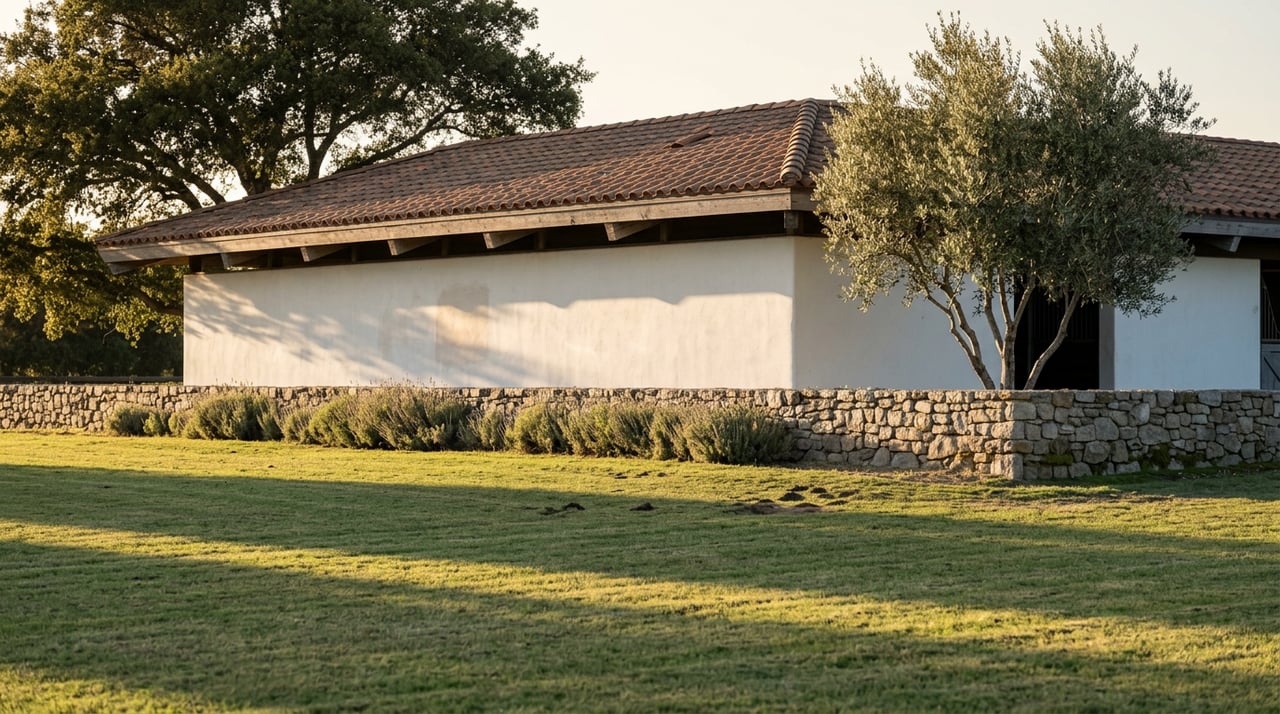
The listing says 2.4 acres in the Hunt Club, flat pasture, room for horses. The buyer walks the lot on a Saturday morning, counts the fence line, does the math in their head, and assumes six stalls means six horses. Three weeks later, in the middle of escrow, that assumption is the reason the deal is still open.
Here is the part almost nobody explains before the offer goes in. San Juan Capistrano does not let acreage decide how many horses a property can legally keep. A specific formula in the city's municipal code does, and that formula cares about flat, usable ground and permit history far more than it cares about the number printed on the parcel map. For a city where equestrian living is part of the identity, that gap between what a lot looks like and what it is legally entitled to do is where a surprising number of transactions lose momentum.
The Math the Listing Sheet Never Shows
San Juan Capistrano's equestrian standards, written into Section 9-3.515 of the municipal code, set a hard ceiling on how many horses a property can keep before the owner needs a Conditional Use Permit.
| Lot size | Horses allowed without a CUP |
|---|---|
| Two acres or less | 4 |
| Between two and five acres | 6 |
| More than five acres | 10 |
That table only tells half the story. Underneath it sits a second requirement that trips up more buyers than the acreage tier does: 2,500 square feet of flat land for the first horse, with a slope no greater than 10 percent, plus another 500 square feet of flat land for every horse after that. A 2.4-acre lot with a hillside pad and a graded flat pocket can fail that test even though it clears the acreage threshold on paper. The listing sheet counts total lot size. The city counts usable flat ground. Those are two different numbers, and only one of them determines what you can legally do with the barn.
The Permit Runs With the Parcel, Not the Person
Here is the piece that catches longtime local families off guard as much as newcomers. If a property's horse density sits above the baseline table, that increase almost always traces back to a Conditional Use Permit the city granted for that specific site. The code is explicit that a density increase stays tied to the parcel as long as the site continues operating under the permit that authorized it. In plain terms, a buyer generally does inherit an existing, properly recorded CUP along with the property.
The friction shows up when the history behind that extra capacity was never formalized. South Orange County has plenty of equestrian properties where a horse or two got added informally over the years, sometimes decades ago, without anyone pulling the permit that would make it official. That informal history does not survive a sale. A buyer who assumes eight horses because the current owner has always kept eight horses may discover there is no recorded CUP behind that number at all, only habit. Verifying the actual permit number and the density it authorizes, rather than taking a seller's word for what has always been true, is the single most useful thing an agent can do before a horse-property offer goes in.
The Ground Is Literally Moving in 2026
Two recent city actions matter here, and both are the kind of detail that only shows up if you are tracking San Juan Capistrano's own planning notices rather than a national portal.
In February 2026, the city filed a Notice of Exemption for an Equestrian Easement Vacation, listed on the city's environmental documents page. Easement vacations remove a previously recorded right of way, in this case an equestrian one. A buyer who assumes a property has trail access because an old plat map shows an easement running along the property line needs to confirm that easement is still active, not historical. The city can and does vacate them.
Separately, in mid-2025 the city entered a ground lease putting operation of the 40-acre Rancho Mission Viejo Riding Park at San Juan Capistrano in the hands of Premier Equisport Events LLC, a private equestrian events operator, also documented on that same environmental filings page. That facility has long been the anchor for the city's broader equestrian community, including groups like the San Juan Capistrano Equestrian Coalition. A private operator running programming under a ground lease is not the same as a city-run community facility, and buyers who are counting on that park as part of the lifestyle value of an equestrian property should understand who actually runs it today, not who ran it when they last read about the neighborhood.
What This Means for Price
Citywide, San Juan Capistrano's median sale price ran near $1.8 million over the three months ending June 2026, up roughly 14.5 percent from the same period a year earlier, with homes moving in a median of about 34 days. That is the number most buyers see first.
It is also not the number that describes an equestrian-zoned or historic-adjacent parcel. This spring, detached home sales in the North San Juan Capistrano ZIP code ranged from roughly $880,000 up to $5.75 million, a spread wide enough that the citywide median tells you almost nothing about what a specific equestrian estate is worth. Part of the reason is thin comparables. There are not many properties in San Juan Capistrano that share the same acreage, the same flat pad calculation, and the same permitted horse density all at once, so pricing one accurately means leaning harder on the property's own documented characteristics than on a tidy set of recent nearby sales. A buyer or seller treating the citywide median as a pricing anchor for a horse property is comparing two different markets that happen to share a zip code.
What to Verify Before You Write the Offer
- The recorded Conditional Use Permit number, if any, and the exact horse density it authorizes. Verbal history from a seller is not a substitute for the permit itself.
- The measured flat-pad square footage against the 2,500-plus-500-per-horse formula, not the total lot acreage.
- The city's GIS parcel layers for any currently recorded equestrian easements, rather than assuming an older plat map still reflects reality.
- Whether any portion of the property sits within or adjacent to the Los Rios Historic District, which layers preservation review on top of standard permitting for roughly forty homes near the Montanez, Rios, and Silvas adobes.
- Whether an existing density increase was approved administratively as a minor increase or through a full CUP, since the process for modifying it later differs.
A Short FAQ
Does buying a horse property automatically transfer the right to keep the same number of horses? Only if that density was established through a Conditional Use Permit properly tied to the site. Informal arrangements that were never permitted do not transfer with the sale.
Can the city reduce a property's horse capacity after I buy it? Not simply because ownership changed, as long as the site continues operating within an existing lawful permit. Separate actions, like an easement vacation, can still affect access even when they do not touch the permitted horse count itself.
Is a property near Los Rios treated differently than a similar equestrian lot elsewhere in the city? Yes. Homes within or near the Los Rios Historic District go through preservation review in addition to the standard zoning and permitting process that applies citywide.
An equestrian property in San Juan Capistrano is rarely just a real estate transaction. It is a set of permits, easements, and flat-pad calculations layered under a beautiful setting, and the deals that close smoothly are the ones where someone checked that layer before the offer went in rather than after. If you are buying or selling a horse property, a hillside parcel, or anything near the historic district, Vasi Vangelos can walk the specific paperwork with you before you write or accept a number. Let's Connect.